
It’s generally not advisable to do a sequel to a film received as well as David Fincher’s The Social Network. That 2010 film made a lot of money and enjoyed critical acclaim and awards recognition at the time, and has only become more beloved since. But the 2021 Facebook leak, which was supposed to be a disruptive game changer but didn’t really change anything substantial, seemed like a perfect chance for screenwriter Aaron Sorkin to revisit some of the themes he tackled in his Oscar nominated 2010 screenplay. Unfortunately, Sorkin wanted to direct this project himself, while Fincher was, presumably, still tied up in his contract at Netflix. However, sometimes even mediocre directing can’t hurt the movie when the script is this good.
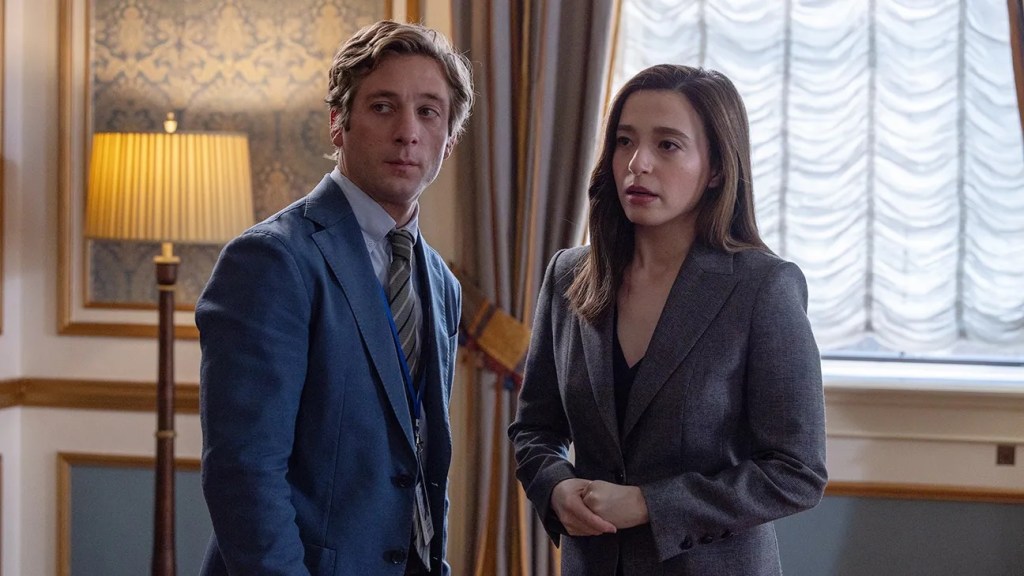
It’s 2019, and misinformation is on the rise, and politics has become contentiously divisive and polarizing in ways that have only gotten worse since then. Frances Haugen (Mikey Madison) works at Facebook, and she believes in its grand mission of bringing people together. Until she discovers the Facebook algorithm encourages divisiveness and lures its members to politically extremist hate groups, after a friend of hers was radicalized by such a group. She starts working with Jeff Horowitz (Jeremy Allen White), a reporter for the Wall Street Journal, in hopes of exposing this as well as the shady practices of Facebook’s CEO Mark Zuckerberg (Jeremy Strong).
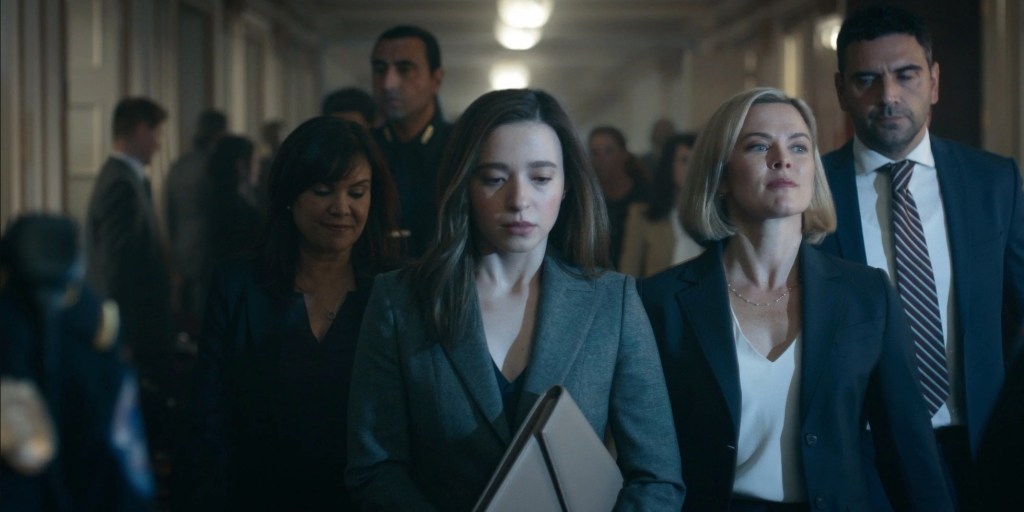
The Social Reckoning works a lot better if you don’t think of it as a direct sequel to The Social Network. With Fincher’s direction and the Trent Reznor/Atticus Ross score, it was technically on another level entirely from anything writer Aaron Sorkin could possibly achieve on his own. It was an electric, explosive, lightning-in-a-bottle type thing. And you can look at any film Sorkin has directed to know he’s a far better writer than he is a director. Because there are certain aspects of Sorkin’s writing that I always respond to, I had a feeling I was going to like The Social Reckoning, even if it was an indisputably not great movie. And my prediction was correct. I found The Social Reckoning to be a timely, urgent and exciting journalistic thriller about people who are desperate to expose our real-life villains. And while it’s admittedly got some problems, I’d like to believe this film could encourage people to speak truth to power again, in a time where we need this kind of hero more than ever.
It helps that the performances in this film are pretty much note-perfect across the board. This is Mikey Madison’s first starring role since she won the Oscar for Anora, and she’s made a very smart career choice because what you leave this film thinking about is Madison’s range. Frances is hyper-intelligent, but also kind of meek and antisocial, and this is a total 180 from what Madison was doing in Anora. This performance, more so than the Anora performance in my opinion, is proof Madison could turn out to be one of this generation’s great actors. She’s clearly got a lot of colors in her paintbox and I’m excited to see what she does next.
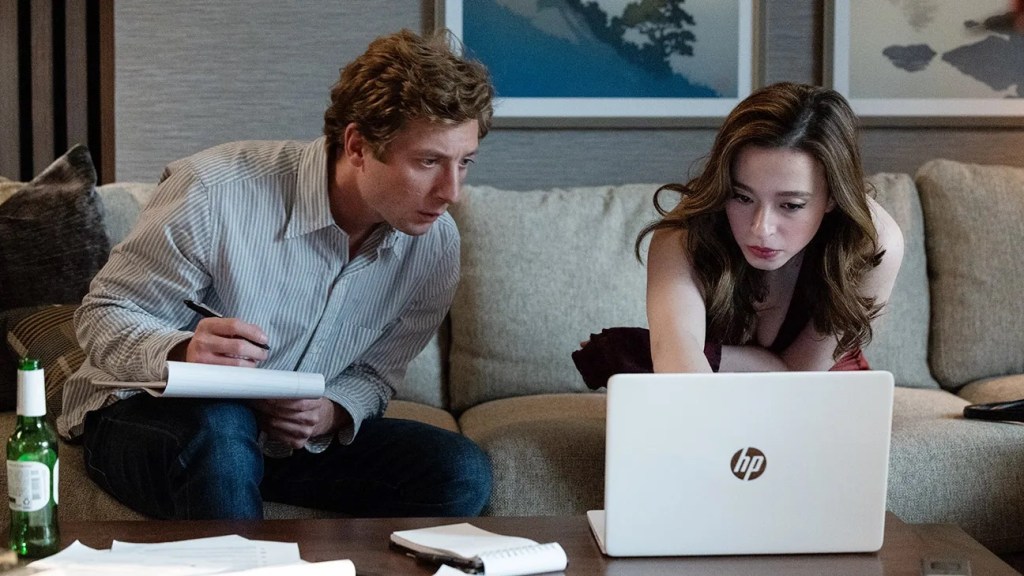
Jeremy Allen White, fresh off his multiple-Emmy-winning run in FX/Hulu’s The Bear, as well as last year’s Bruce Springsteen biopic, also seems to be very savvy about his career choices. He fits in very well with Sorkin’s rapid-fire, walk-and-talk, ratatatat dialogue style, and White seems to understand, and be comfortable with the fact that he’s never the most interesting person in this story. But he’s a steady anchor for this narrative and I’ve always found White to have a commanding and compelling presence, and a lot of what I like about him as an actor is fully on display in this performance.
A lot has been written about the choice to replace Jesse Eisenberg with Jeremy Strong, as the actor playing Facebook CEO and real-life supervillain Mark Zuckerberg. I personally don’t think it was a bad choice for a few reasons. One, Sorkin has said he doesn’t see Reckoning as a direct sequel to Network, but more of a companion piece. Two, structurally they don’t feel similar at all. Three, since 2010, Zuckerberg has fully embraced the whole ‘demonic alien wearing a human skin suit’ thing and this is exactly what Jeremy Strong is doing, and I’m not sure I’d want to see Jesse Eisenberg do that. He’s positively chilling in this role, and nails Zuckerberg’s creepy and off-putting physical appearance as well as his smug, self-satisfied demeanor. I thought his performance really worked but I can also see the perspective that maybe he goes a little too far with it. I don’t agree with that perspective, but I can see it.
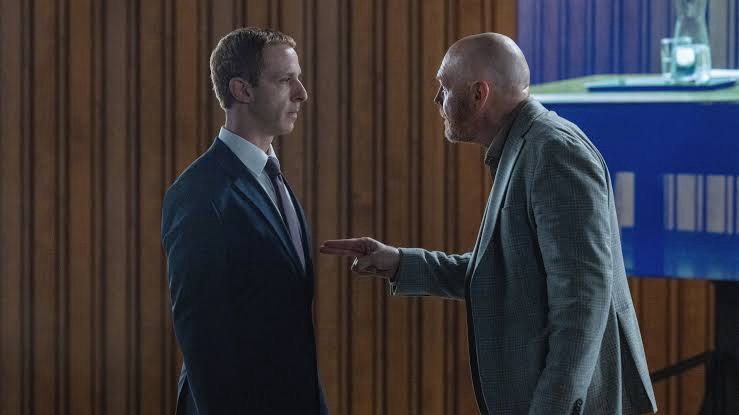
We’ve got a murderer’s row of supporting players here as well. Bill Burr plays one of Facebook’s original investors who kind of serves as a voice of reason to Zuckerberg’s growing insanity. Sinners’ Wunmi Mosaku stars as a crisis management specialist assigned to Zuckerberg, and she’s mostly here to deliver exposition, but she’s got a strong presence. Betty Gilpin stars as Jeff’s boss, and she’s playing this very cold and clinical, with a biting sense of humor and I wish the film had more of what she was giving to it. Same goes for Billy Magnussen, who, over the course of his career, has been very smart about weaponizing his handsomeness and charisma into something more sinister. None of them are in enough of the film, but all these supporting players add to why the film ultimately worked for me.
The tech aspects here are almost completely unremarkable, but since such strong attention is paid to the screenplay and performances, I barely even minded. Jeff Cronenweth, who usually works with Fincher, and also shot The Social Network, is our cinematographer. And I can’t quite figure out why he shoots this like it’s a bland procedural crime drama you’d find on CBS. The great Alexandre Desplat composed the score, but it can’t hold a candle to the iconic work from Trent Reznor and Atticus Ross in The Social Network. And while I shouldn’t compare this to Fincher’s 2010 film, sometimes it’s hard not to.
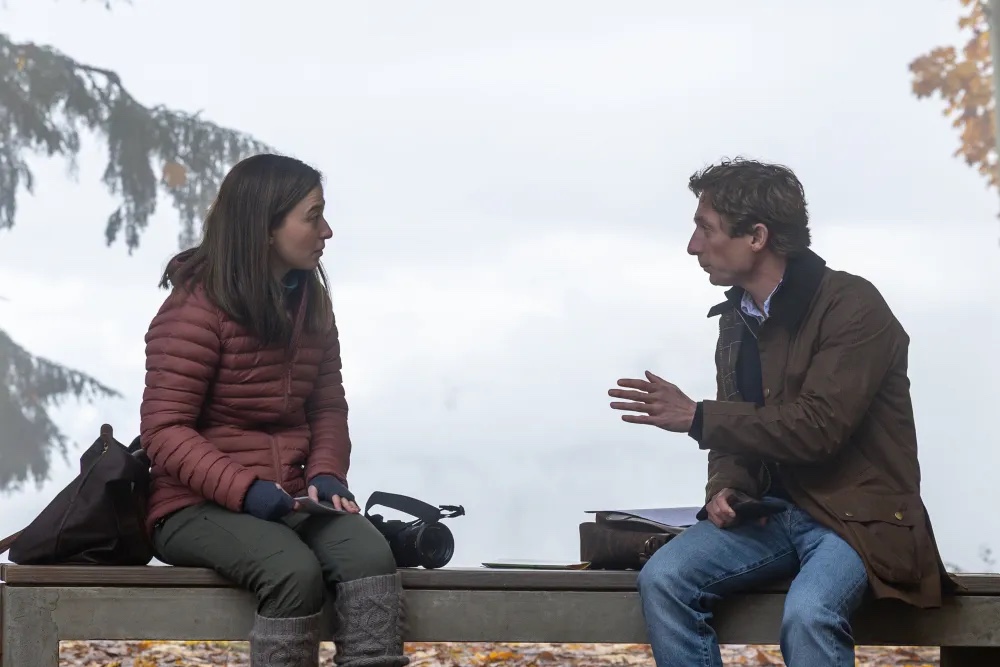
A thing I always like about Aaron Sorkin is his earnestness and his optimism. He so clearly wants his heroes to save the day and emerge triumphant. This is something that started with The West Wing and never really ended. This film ends on title cards summarizing what’s happened since the events of the film in 2021, detailing how nothing has really changed for the better involving the sinister ways in which social media companies operate. And then he cuts to our two main characters standing across a room, sharing a triumphant look, with Madison walking away raising her fist in the air like the end of The Breakfast Club. And this is something the film doesn’t really earn. None of the heroes has really been remarkably triumphant here. The bad guys have won yet again, but Sorkin clearly wants this film to be a rallying call to inspire real-world change, and although that might be overly earnest and faux-inspiring, I left the film thinking maybe we do have some fight left in us.
I could see how one would find this to be a bore, or a too-little-too-late indictment of some of the worst and most powerful people in the country right now. And the fact that I’m going to post this review across all my social media accounts and it will no doubt be stifled in favor of damaging misinformation, is not lost on me. And the heavy-handed, clobbering you over the head with its message nature of this film might feel like too much for you, for the same reasons last week’s Digger felt like too much for me. But from my vantage point, Aaron Sorkin has written yet another fantastic screenplay and assembled a team of the best actors for its roles. It feels more like All the President’s Men, or Spotlight or She Said than it does The Social Network, but that’s always going to be the kind of film I respond to. If you go in expecting that, I think you’ll find this to be a worthwhile experience.

