
I’ll start this off by saying I don’t really get Colleen Hoover. Hollywood keeps adapting her books, and it seems like she’s overtaken the spot in this business once occupied by Nicholas Sparks, who I also never really liked. Her feature adaptations always make money even if the critical reception of these films has repeatedly been lackluster. I’ve tried to read Hoover novels (Reminders of Him, Regretting You) before seeing their film adaptations and have never made it through to the end, for a few reasons. I find her characters pretty ridiculous and unlikable most of the time and her writing seems to be more interested in soap opera-adjacent melodrama rather than anything that seems emotionally recognizable as a human being.
But I thought I’d give her one more chance, because I’d only attempted her boring romance novels, and Verity is Hoover’s first thriller to be adapted. Everything I’d heard about the movie adaptation intrigued me. When I borrowed Verity from Kindle Unlimited (like hell was I going to spend actual money on a Colleen Hoover novel) I was surprised to find I actually could make it through to the end. I could never finish a Hoover novel before and I wasn’t going to force myself to finish this one. But I was interested to see how the novel would stick the landing, and when I finished the book I thought, well, there are things here that work and things that don’t, but a lot of things that a movie adaptation could fix. Director Michael Showalter’s adaptation of Verity does not fix any of the problems in Hoover’s novel. Instead, it creates a whole bunch of new problems.
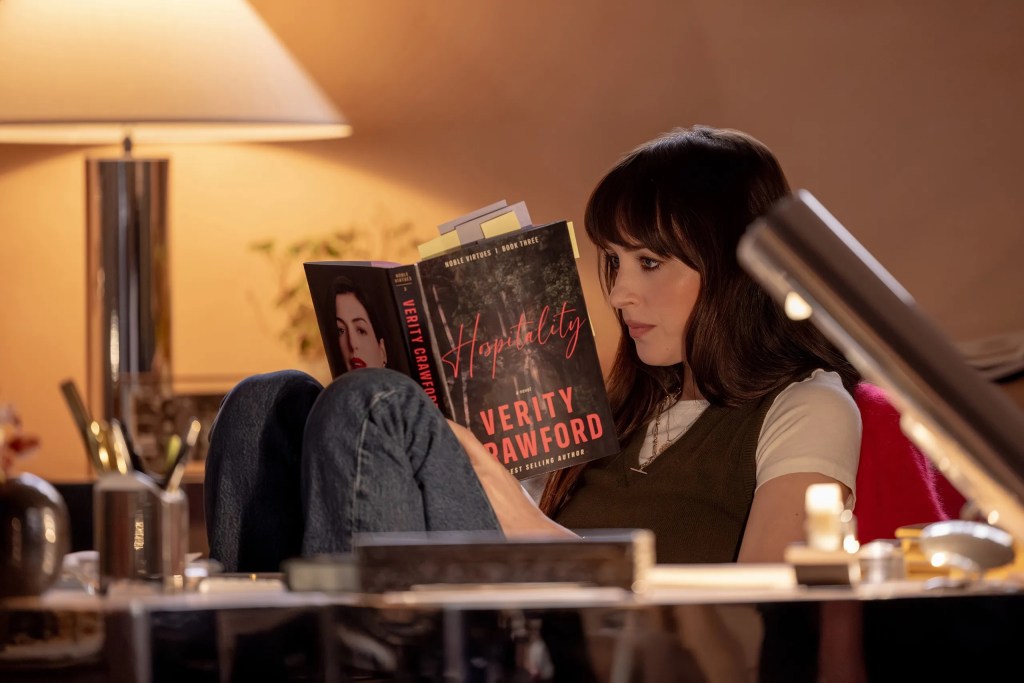
Lowen (Dakota Johnson) is a struggling author who is contacted by the team representing author Verity Crawford (Anne Hathaway), who has recently been in a terrible car accident leaving her in a catatonic state. Verity’s husband Jeremy (Josh Hartnett) wants her to swoop in and ghostwrite the remaining three novels in his wife’s uber-popular book series, all told from the perspective of the villain, and this is laughably portrayed as a novel concept that’s never been done before. In order to do this, Lowen comes to their grand estate in rural Vermont and immediately gets way too involved in the lives of this family. While Lowen starts to learn more about Verity and starts crushing on her husband, she comes across a flash drive containing Verity’s memoir. The tone of this memoir is brutal, dark and shocking. And Lowen will soon learn Verity’s warning in the opening pages is frighteningly true – ‘there is no light where we’re going. Only darkness ahead.’
Remember that time in the mid-2010s where every semi-popular trashy airport thriller was adapted, hoping to recapture the success of David Fincher’s Gone Girl? It became something of a joke to describe a movie as ‘Gone Girl, but…’ I’m referring to the lackluster adaptations of The Girl on the Train, The Woman in the Window, and so on. This kind of became a genre unto itself and it looks like we’re still doing that. Michael Showalter’s adaptation of Verity has Johnson’s character say at one point ‘I don’t read novels you can buy at the airport,’ and I had to laugh because that’s literally Colleen Hoover’s whole thing. And I’m an easy sell for the trashy airport thriller, which is probably why I was interested enough in Verity to see it through to the end. And I cannot believe I’m saying this about a Colleen Hoover adaptation but I think the book might have been better.
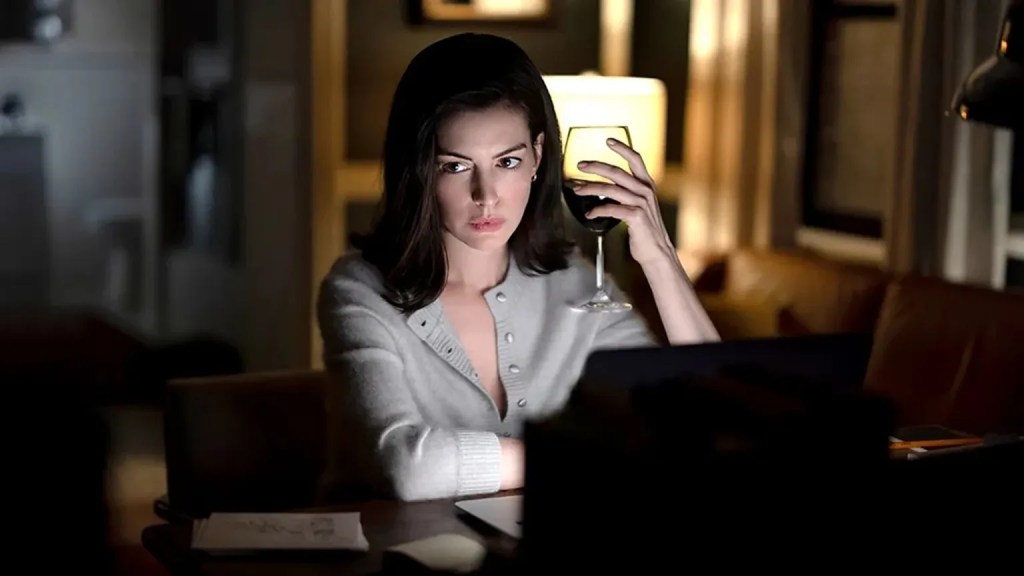
I’ll start with the one thing that’s consistently working, and that’s Anne Hathaway. Hathaway has had an incredibly busy year, and she’s done so much good work that I’ll forgive her for wasting her time in a Colleen Hoover adaptation. Hathaway seems to get exactly what this movie is. She’s got this overly dramatic, golden age of Hollywood movie star vibe to her presence, and Hathaway is clearly having fun with it. She’s leaning into the inherent absurdity and campiness in the source material, every line reading with an almost mid-Atlantic purr. But Nick Antosca’s screenplay never lets her fully let loose and embrace the absurd, and that’s a problem. The movie isn’t doing enough with Hathaway, and that’s a bigger problem considering she’s easily the best part about it.
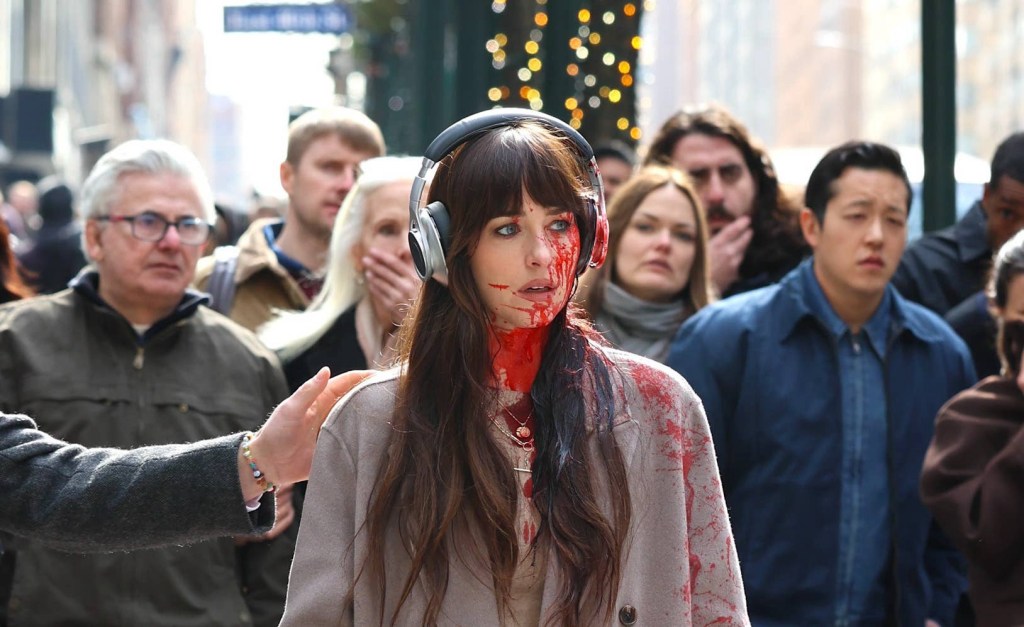
Dakota Johnson is also game for this, but she has to walk a more complex tightrope than Hathaway does. The viewer is never sure if they’re supposed to like Lowen. In the novel, it became clear the reason this was working for me more than other Hoover novels I’d tried to read was that you were clearly not supposed to like any of the characters. Hoover is usually desperate to wring empathy from the reader or viewer consuming the story, and I liked that this novel was basically telling you these were all terrible, rotten people. Johnson wants to play her as a complicated protagonist, but for a lot of the movie, her character is mostly reduced to just reacting to things. After a certain point it’s clear this can’t be saved, and Johnson seems to proceed on autopilot, kind of like she did in 2024’s beleaguered Madame Web.
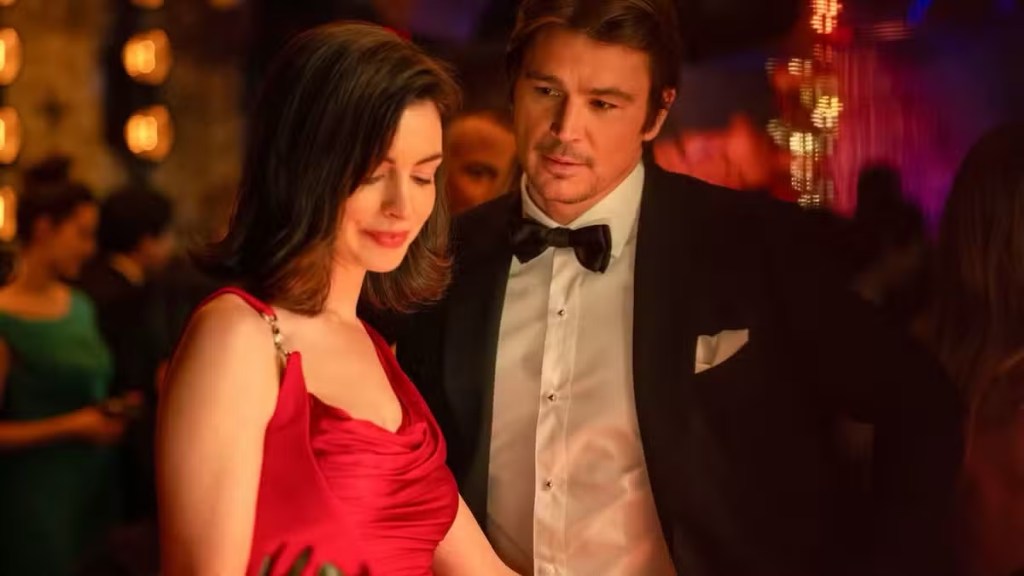
I’m here for the Josh Hartnett comeback that’s been happening over the past several years. An early oughts heartthrob, Hartnett has had more success as a character actor as he’s gotten older, and he’s gradually becoming more interesting to watch. However, I can confidently say he wasn’t the right choice for this role and that’s mostly to do with reasons that are spoilers, so I won’t get into them. But also because he doesn’t really have chemistry with either Hathaway or Johnson. His performance seems strangely detached and flat but I think that’s more the script’s fault than Hartnett’s fault. There’s nothing about the character that seems emotionally true, and also nothing that works when everything with the character goes off the rails in the second half.
Perhaps this could have been saved with a female director, it’s hard to say. But I will confidently say Michael Showalter was not the right person for the job. He’s a director mostly known for comedy, but his film isn’t leaning hard enough into the inherent ridiculousness or campiness ingrained in the story. It’s taking itself far too seriously and that becomes boring rather quickly. Nick Antosca penned the script, and he’s mostly written for television. I often wondered if Verity would work more as a miniseries, because Antosca’s script is paced terribly. The pacing slows down to a crawl for a long time in the middle and then defibrillates itself back to life in the last 20 minutes, and for the viewer that’s jarring and unsatisfying. Again, maybe if this film had a female creative team, this fatal disconnect wouldn’t be as evident. Paul Feig is the only man who could have made a good Verity movie, but he already made that movie last year (The Housemaid.)
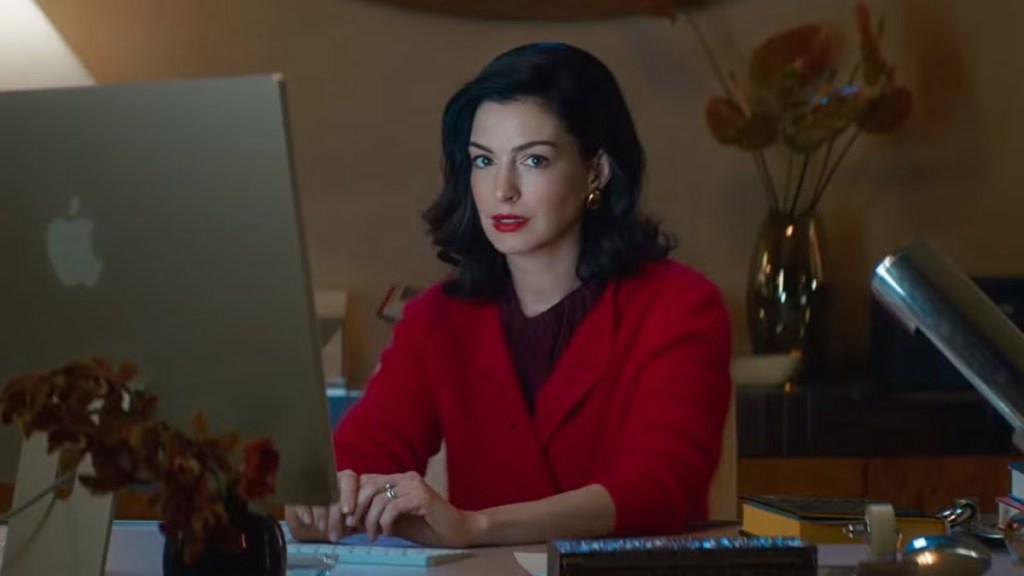
I have to give credit to the only thing I consistently liked about this movie other than Hathaway, and that’s the production design. Amy Williams designs the house where most of this film takes place thrillingly. It looks like the classic movie villain house with lots of glass, stone and sharp edges, and that’s always been a place I’d love to live. The design of Verity’s office, in particular, is jaw-dropping and beautiful. Costume designer Jacqueline Demetrio is also leaning into the physical similarities with Hathaway and Johnson in ways that make sense for the story. Volker Bertelmann composes the score and he’s going for a Bernard Hermann vibe, but it doesn’t really work.
The fatal flaw of the Verity movie is the ending. The ebook I read to prepare for this movie had an epilogue that I later found out was not in the original novel, and was added in later editions. This epilogue makes the ending. It doesn’t fully resolve the ambiguity the original ending gives you, but it gives you more context, and changes the perception of everything you’ve just read a little more than the original ending. This epilogue is the best thing about the novel, and this movie entirely omits it. I find this incredibly frustrating, because the bang the novel ends with is reduced to a whimper. A story like this really lives or dies on whether or not it can stick the landing, and the fact that Hoover’s novel managed to do a better job of this is baffling and infuriating. If you’ve read the earlier version of the book sans epilogue, I’d advise you not even to research what it changes. Because while this adaptation was making a lot of mistakes that annoyed me throughout, the ending was the thing that killed it for me.
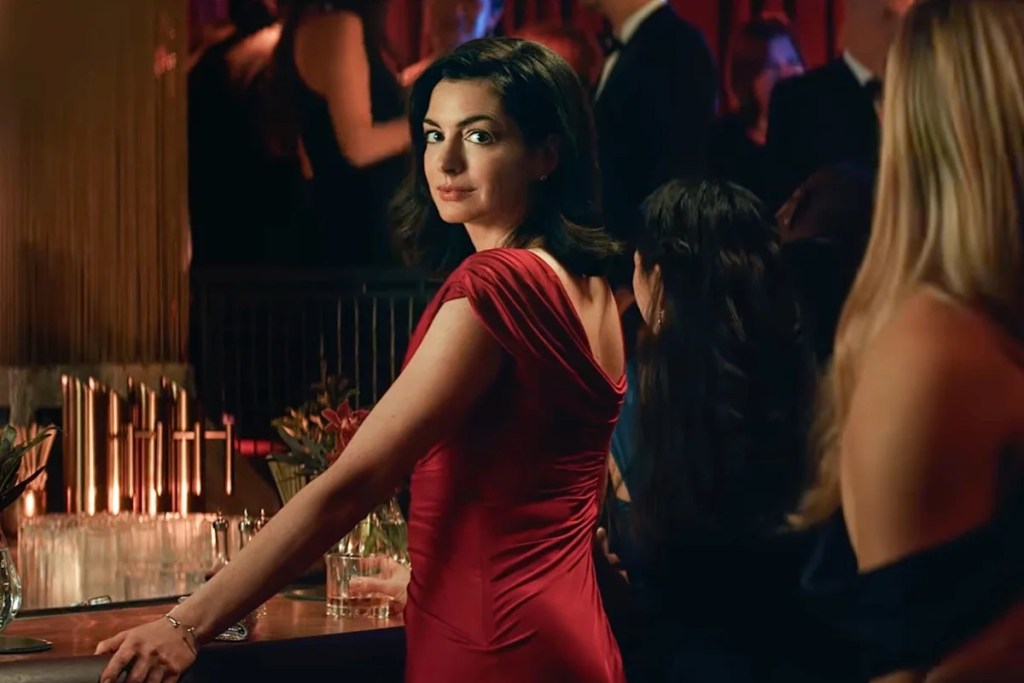
Fans of the novel might not be as dismayed by the movie as I was. It’s mostly faithful to the source material, it’s hitting all the same beats. But if the source material is coming from Colleen Hoover of all people, and that source material is better than the movie, we’ve got a serious problem. Verity is a disjointed, unsatisfying, melodramatic and unintentionally funny slog that’s never as exciting as it should be and is never leaning into camp as much as it should. Michael Showalter had a real chance here, a chance to adapt a book that almost works a lot of the time into a truly memorable movie. Instead, this is a movie I’ll probably forget about entirely a week from now. Verity strands its talented cast in a monotonous hell of its own making.

