
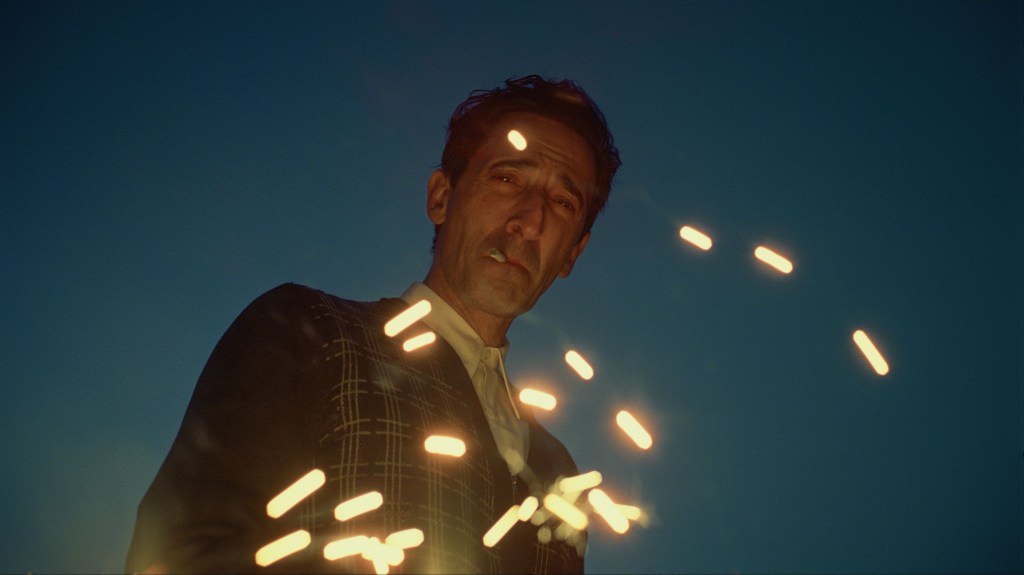
Writer/director Brady Corbet’s The Brutalist has been one of my most anticipated films of this year, and that has been based solely on what I’ve heard people say about it out of film festivals. Corbet won the Silver Lion at the Venice International Film Festival this year, and every review has just been gushing with praise about what Corbet has achieved here. Not wanting to know much about the film before seeing it, I purposely avoided actual details about this film, but still walked into my screening last night with high expectations. And that might have been the problem. The Brutalist is an incredibly well made film, one that left me a bit cold.
László Tóth (Adrien Brody) is a well-regarded Hungarian architect who has just escaped the Holocaust, after being separated from his wife Erzsébet (Felicity Jones). László has just arrived in America, and takes a job working for his cousin (Alessandro Nivola)‘s business. Eventually he is hired by a wealthy industrialist (Guy Pearce) and his son (Joe Alwyn) who see his potential and commission him to design a series of buildings in suburban Philadelphia. He also promises to bring László’s wife and niece (Raffey Cassidy) to America. Complications and dilemmas ensue as László pursues the American dream.
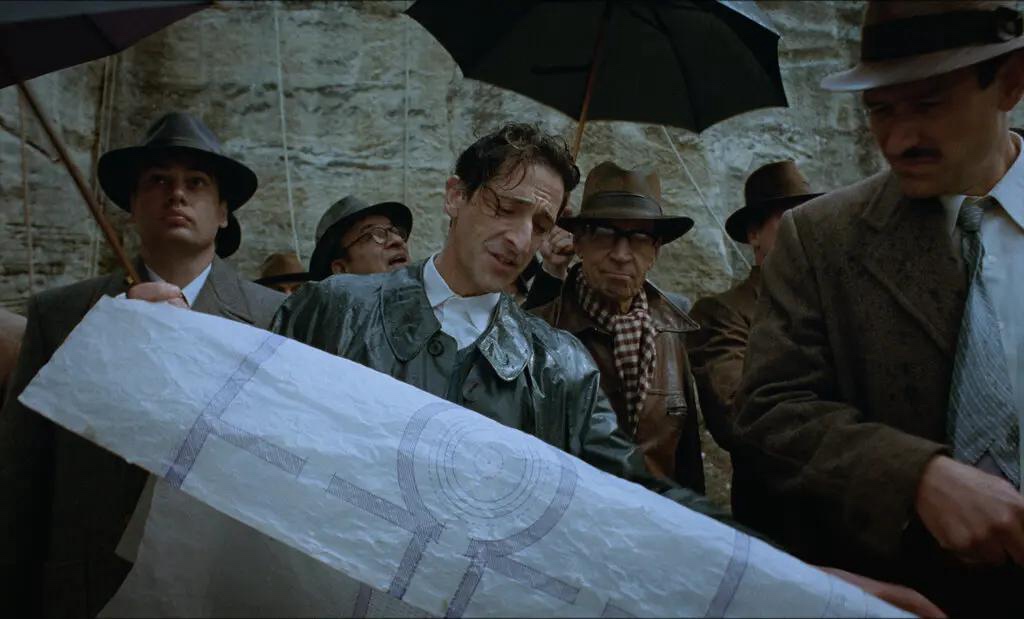
The Brutalist runs about 3 hours and 35 minutes long, and it has an overture and an intermission. This is such a loving throwback to the kind of American cinematic epic, the kind that we don’t really get anymore. A colleague at my screening described an interaction with a teenage theater worker who didn’t even know what an intermission was. And I personally believe that for anything over, let’s say, two hours and 15 minutes, we should have an intermission. We do it for live theatre, we should do it for movies. If you go to the opera, and you see a performance that is as long as The Brutalist, you get two intermissions. It has to be good for theaters, since you’re more likely to get the big soda and popcorn if you know you have a break coming up. So I don’t see why we’re so averse to this. Maybe Brady Corbet can bring the intermission back. One can hope.
The Brutalist is the kind of experience you won’t have in another movie this year. It’s incredibly ambitious, it’s enormous in scale, its themes are vivid and thoughtfully explored. And Adrien Brody is doing some of the best acting I’ve seen all year. So much about The Brutalist is so striking and works so extraordinarily well, that it’s a bit frustrating to me that for this narrative, we really do not need the 3.5-hour runtime. The first half is rather languid in its pacing, and it took me a good hour or so to really get into this story. And the second half is messy. And we end on an epilogue that feels tacked on and cheapens the entire story.

Adrien Brody has not had a chance to give this kind of performance since 2002’s The Pianist, and this is a great reminder of what he can accomplish as an actor. He’s nailing the complicated accent work and the big emotions his character experiences over the course of this narrative. However, László is not a particularly interesting character. He is put through the wringer in a number of ways, but he always seems like he’s trying to do the right thing. He’s the kind of character who things are just happening to, who is passive in his own story and that kind of annoyed me throughout. But maybe this is an honest depiction of what the immigrant experience was like at this time in history, and the unrealistic expectations set by the concept of the ‘American dream’. But that still means these characters are more like ideas than they are fully developed people.
Felicity Jones is also nailing some difficult accent work, but I also feel like what the film gives her to do is not all that great. She sweeps in in the second half and she’s lied about a health problem that has put her in a wheelchair. She complains and looks at people with disdain. That’s her whole character. Corbet’s script, cowritten with Mona Fastvold, doesn’t seem particularly interested in her inner life and seems to be bringing her in just to shake things up in the second act. Jones has a few good moments, and some showy monologues, but as a whole it feels like this character is limited. Guy Pearce, as the wealthy man who hires László, is doing terrific work here, however. He’s intimidating, he’s smarmy and even when he’s saving our protagonist’s day, there is something we just don’t trust about him. And as a result, his performance is a masterclass on the same level as the work Brody is doing.
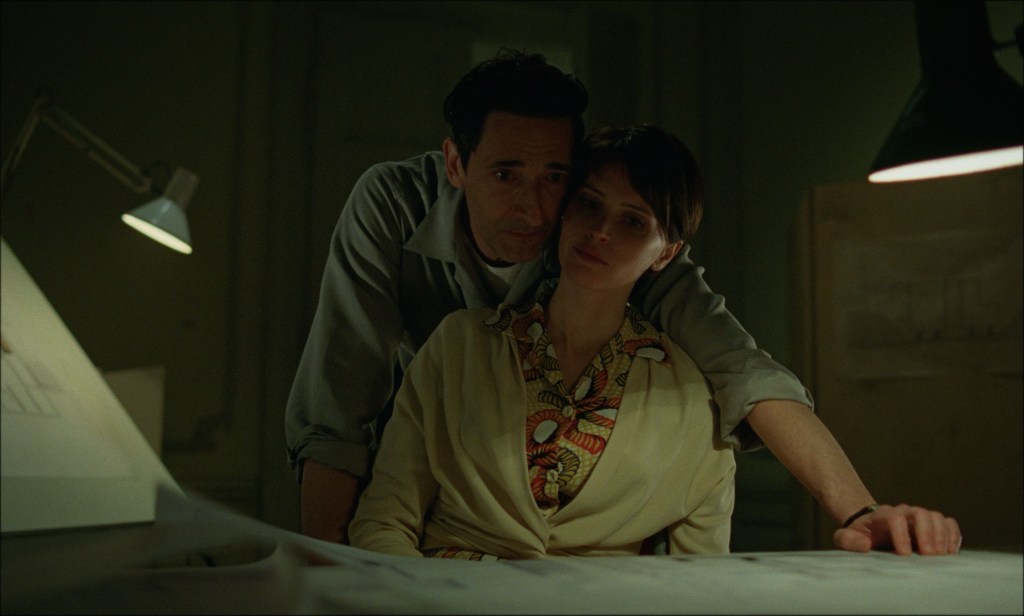
This seems like a shoo-in for awards season cinematography and score categories. Lol Crawley, who previously shot Corbet’s previous two films, returns here, and we have lots of unbroken long takes that go on for several minutes and the choreography involved with making that work is very impressive. Crawley shot the film using the now widely forgotten VistaVision process, and the choice to have used film stock as opposed to digital absolutely adds to the film’s sense of time and setting. The score from Daniel Blumberg is just about perfect, and is never overpowering but effectively establishes the mood and the enormity of this undertaking throughout.
It’s a dangerous thing when expectations play into how one watches a movie. If I had not gone into The Brutalist expecting to be absolutely blown away, I may have actually been. But as it stands, Brady Corbet has undoubtedly made the strongest film of his career so far, and there is so much here to appreciate in the scale, the performances and the sheer ambition of this story. It may have stopped just short of resonating with me emotionally in the ways intended, but there is still a lot here to admire. Unfortunately, it sometimes feels like Oscar season homework, rather than a film that really shakes you to your core. But ultimately I’m not sure if that is a detriment that means anything. The Brutalist is a bold, ambitious and towering cinematic achievement, and will likely be remembered as one of the year’s essential films.
 Salt Lake Film Review