
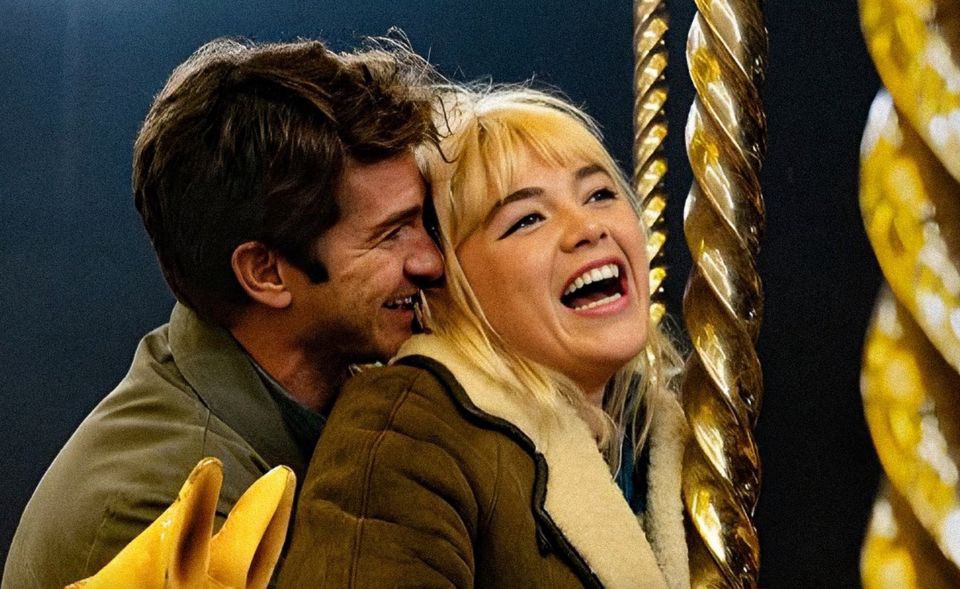
An old-fashioned studio weepie usually works on me. There is a lot I can forgive in a not-great movie if it does the all-important trick of hitting me emotionally. A doomed romance or a story about someone fighting a terminal illness can often elicit a visceral response emotionally for me. You have to be doing this kind of thing very incorrectly to not get that reaction from me. And director John Crowley’s We Live in Time was a film I was very much looking forward to. I love a good movie cry, and you’re giving me two of the most exciting actors in Hollywood right now playing a couple. What could possibly go wrong?
In a jumbled narrative told out of order, we are introduced to Almut (Florence Pugh) and Tobias (Andrew Garfield). She’s a gourmet chef and restaurant owner, he’s a rep for Weetabix breakfast cereal. We eventually see how they met, when they talk about having and finally have a child together, and the devastating illness that threatens to tear them apart. We follow their doomed romance over the course of several years.
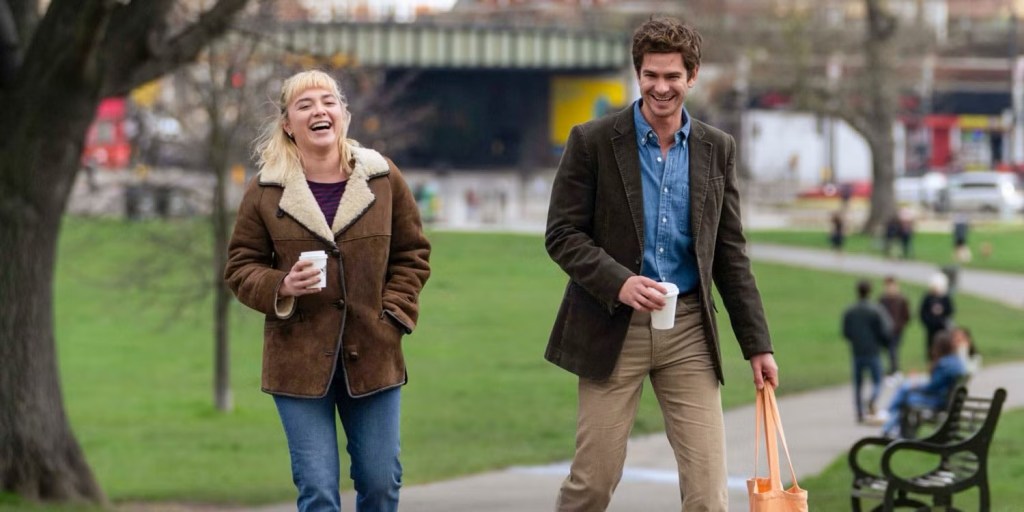
The choice to tell this story out of order feels like a curiously distancing and oddly cynical decision. It feels like it’s a device used to give this very familiar narrative some arthouse gloss. It feels like a decision made for no other reason than to set this apart from the so many other movies exactly like it. And that’s a bad decision, because if the worst thing I could say about this movie was that it’s too familiar or too sentimental, I still probably would have given it my approval. However, we have this story that is inherently familiar that is structured in a way that is meant to consciously put the viewer at a distance. We Live in Time has the intention of reaching for loftier heights, but feels cynically averse to the movie-of-the-week that exists within it. And in the end, it just feels like a fake arthouse Lifetime movie, made by people who should know better.
Florence Pugh and Andrew Garfield have lovely chemistry, and they have some great moments of playing off one another. However, both of these characters kind of suck. She’s incredibly selfish, from the beginning of the relationship well up until the point she becomes gravely ill. She’s making decisions that are kind of unjustifiable and dismissive of the alleged love of her life, and later her child. And he’s kind of nothing. He’s a divorcee, we never learn anything about his previous marriage. He works for Weetabix, but we never learn anything about what that entails or what his dreams and aspirations are. He’s just the adorable, supportive spouse who will just go along with it when she acts like a monster.
The problem is, as a viewer of a film like this, you’re asked to go along with all of this, if not to become deeply invested in this love story. And you’re supposed to care when she gets sick and is on the brink of death. You’re supposed to understand when she acts like a jackass, and you’re supposed to find her brave, I think. I found her irredeemable. Maybe Crowley and screenwriter Nick Payne are just misogynist and want to make the woman in this relationship just the worst, and have the man be the charming, doting, lovely one, who always says and does the right thing. And ultimately, you are supposed to root for this adorable couple to fight the odds and emerge triumphant. But I literally never, not even once, cared.
Director John Crowley gave us the excellent Brooklyn, and the utter fiasco that was The Goldfinch. So, in my opinion this is another miss for the filmmaker, although it seems many viewers are not having the experience I had with this. Tony nominated playwright Nick Payne wrote the script, which feels like it could use another draft or two. Not much to say about the score or cinematography. It’s a nice looking film, even if it is a poorly put together one on many levels.
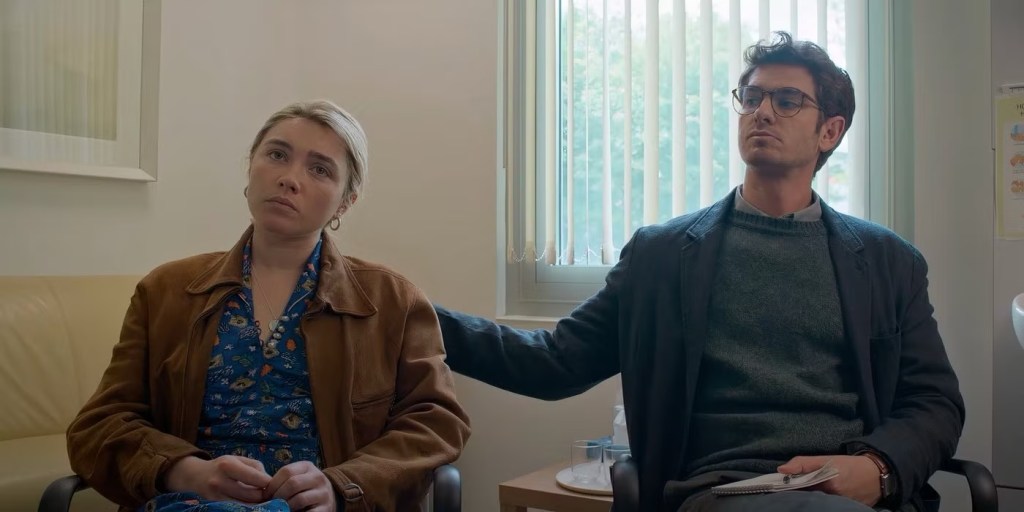
It’s frustrating how this story is assembled. A good example involves perhaps the film’s biggest moment of pure, genuine joy, smash cut to our central couple sitting in a doctor’s office and her head is shaved. Also, we learn about her illness before we even see the initial meet-cute. If there was something this was trying to say about the way love transcends over time and space, and whatever, that was totally lost on me as a viewer. Assembling this story as a put-it-together-after-the-fact just feels like the wrong decision for a number of different reasons.
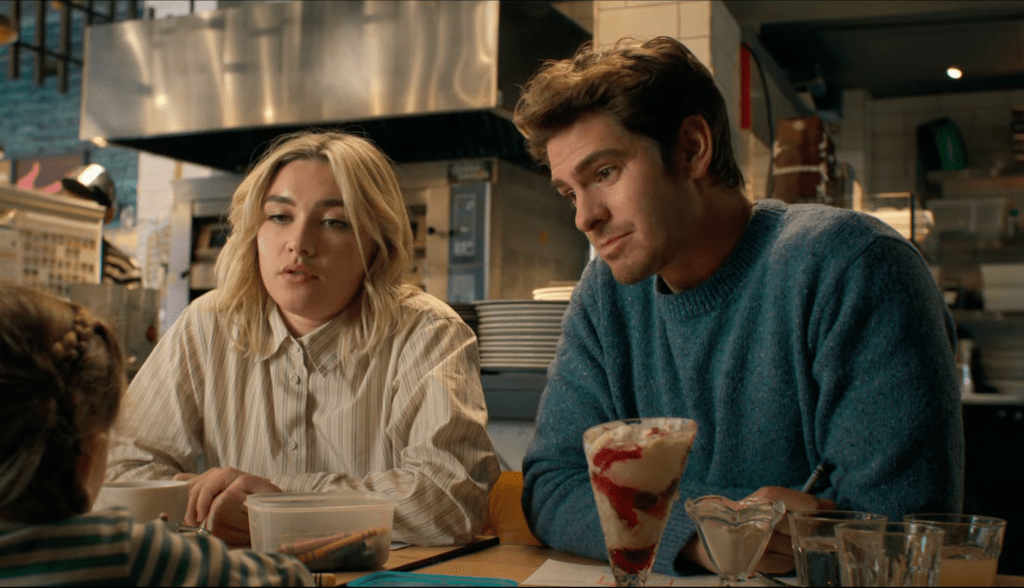
The biggest problem with We Live in Time is it never moved me. I never cared for these people, I never felt the sense of life-altering romance or intimacy or urgency in anything that was happening. The moment that’s supposed to be this big climactic setpiece involving Pugh’s character at a cooking competition, also meant to highlight her ‘love’ for her family, lands with a thud because of all that came before it. Honestly, this is a hard film to talk about because I really wanted to love this movie. I thought it would be very hard to go wrong with this fantastic duo at the center. If it all came together for me in the end, I’d go back to the theater multiple times and cry each time. But I left We Live in Time feeling empty and feeling nothing, and I’ll probably never watch this again.
 Salt Lake Film Review