

The time has come for us to discuss one of this year’s (to me) most anticipated films. I have been reading about Francis Ford Coppola’s Megalopolis forever. The story behind the making this movie is the stuff of cinematic legend. The idea for it, if Coppola is to be believed, has been floating around since he finished Apocalypse Now, in the late 1970s. He has never been able to get a studio to fund this expensive, experimental project. He ultimately put up $120 million of his own money (more recent reports have suggested that number to be a lot higher) and sold a division of the winery that he owns, to fund this passion project.
But where is the line drawn between the passion project and the vanity project? How did the great Francis Ford Coppola have his first film in over a decade premiere at the Cannes Film Festival earlier this year, and have the responses be so wildly divided, with critics pretty much in equal measure praising the film and calling it one of the worst films of all time? How did the search for an American film distributor take so long for a Coppola film, only for the down-on-their-luck-these-days Lionsgate agree to distribute it, only if Coppola himself would agree to bankroll the film’s marketing costs? And never mind all that, how is the actual film itself? Was all of this worth it in the end?
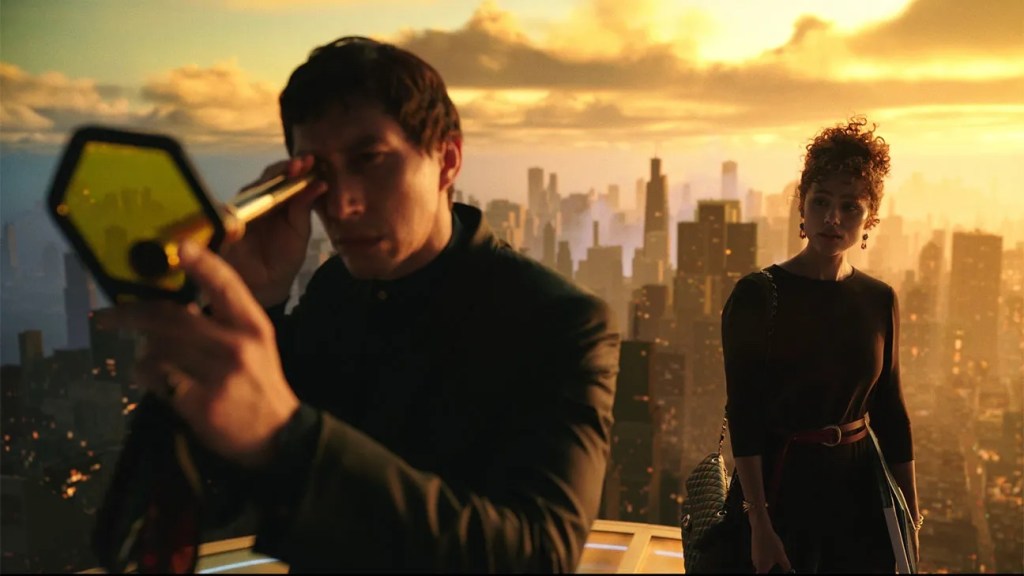
Cesar Catalina (Adam Driver) is a man grieving the death of his wife, who can (even though this doesn’t factor into the plot in any important way) sometimes have the ability to make time stop. He is an idealist architect living in the futuristic New Rome, which is basically New York City. New Rome is decadent and is decaying. He has a vision for an alternate utopian city called Megalopolis, but the construction of that city would involve the complete demolition of New Rome. The city’s mayor (Giancarlo Esposito) opposes this idea, and many who follow him are content with things staying the way they are. When he falls in love with the mayor’s daughter (Nathalie Emmanuel), the struggle for power and control over the people of New Rome hits a boiling point.
I admire the ambition and the level of tenacity and chutzpah it took for Coppola to make this thing happen. When a director is so committed to the theatrical experience, insisting the film be shown on IMAX theaters, it turns the moviegoing experience into something of an event, which is exciting. In select theaters, there was a gimmick where the house lights would go up during a scene where a press conference was happening, and a living, breathing person would walk up to a microphone in front of the screen and ask the Adam Driver character a question and he would answer it. And like I said, all of the news out of the festivals and the fourth-wall-break thing made this feel like an event. And even at the IMAX screening I attended last night (where the fourth wall thing didn’t happen), the energy in the room was strong. But something, somewhere here went terribly wrong.

Megalopolis is one of the most bafflingly incoherent viewing experiences I’ve ever had in my life. The last time I sat in a movie theater with my jaw dropped for so much of it, in utter disbelief and shock of the batshittery presented in front of me, was Tom Hooper’s legendarily awful adaptation of the musical Cats. There are long sequences in Megalopolis that don’t make any sense at all. There are long, rambling theatrical speeches, including a dramatic Shakespeare reading that happens for no particular reason, that grind the film to a halt. There is no sense of narrative cohesion, and it feels like the storytelling Coppola is attempting got away from him in spectacular fashion.
Megalopolis is a rallying cry for studio notes and the strongest case yet I’ve seen that executive interference in the creative process might not be such a bad thing after all. There are multiple storylines in Megalopolis that go nowhere. There are characters we are introduced to that are completely abandoned mid-movie, and then show up in a climactic way that makes no sense in our third act. Some of our best actors are giving baffling performances, and nobody quite seems to understand what the movie they’re in is.

It is simultaneously one of the most beautiful and most ugly movies I have ever seen. The costume design is beautiful, but there are so many sequences with some of the worst green screen and some of the worst CGI that I’ve seen in my life. Coppola is throwing so much at the viewer, and is never really saying anything, never giving the viewer anything to take with them, other than the film’s most basic observations about society, comparing we are right now to the fall of the Roman Empire. There are so many interesting places we could have gone with that singular idea, and we never do.
The performances here are also either ridiculous, or not much at all. Adam Driver is supposed to be the audience conduit into this world, but is really just a mouthpiece for Coppola’s own ideologies and theories he is using this film to convey. If you saw the 2020 film Annette, starring Driver, that will give you an idea of what to expect here. Nathalie Emmanuel is playing this like a straight drama, with no nuttiness or weirdness, and it feels like our two leads are in completely different movies. But not as wildly different of a movie as the one Shia LaBeouf and Aubrey Plaza are in, who are almost acting like they’re in a full-blown comedy. Even Aubrey Plaza, who has gotten out of some genuinely terrible movies unscathed, seems like no one let her in on the joke.
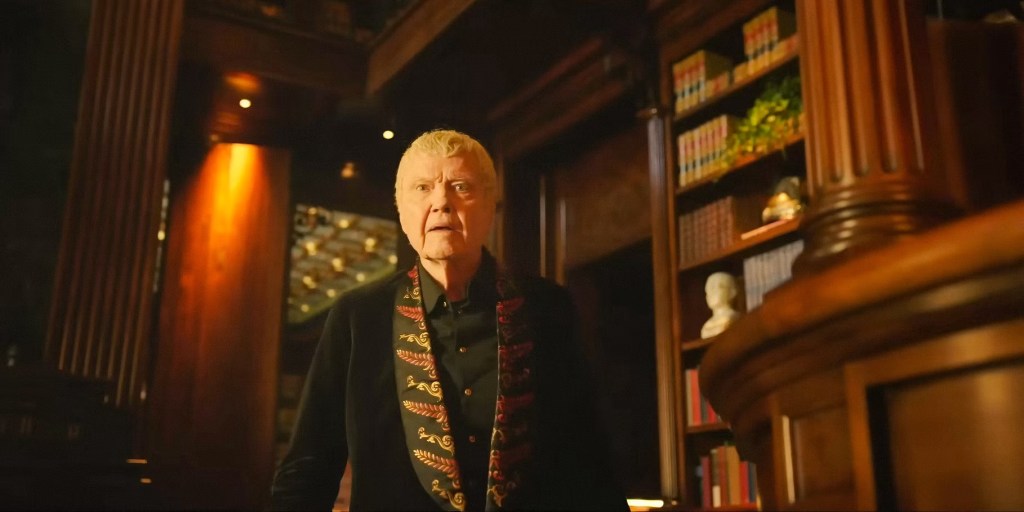
We also have some truly bizarre work from Jon Voight, who looks frail and appears to be drunk in every scene. Is that character work or was the actor actually inebriated the whole time? Who’s to say? Dustin Hoffman is also here in a few scenes, speaking with a weird lisp or accent or something, that make most of his lines incomprehensible. Laurence Fishburne has double-duty of playing Cesar’s assistant and also the narrator, who reads the film’s many, many title cards to us. We also have Jason Schwartzman, in a nothing role where he is chewing every bit of scenery imaginable, and Grace VanderWaal as a virginal pop star wrapped up in a sex scandal involving internet pornographic deepfakes, one of many side-plots in Megalopolis that means nothing and goes nowhere.
Coppola’s script seems like it needs several rewrites, or maybe just needed someone (anyone) in any corner of the room telling him no. It’s reminiscent of a film student’s freshman year project, where a plucky young student will have lots of ideas and be convinced so many of them are brilliant, and will design a movie around them, and force friends and family to suffer through its final result. It’s also like if you visited your dementia-ridden grandpa in the nursing home and you let him ramble endlessly for two and a half hours about the good old days and how we live in a godless, hedonistic dystopian society today and we’re doing everything wrong, and then he goes on to whine about how his worldview would have led to peace on earth. He’ll talk about how recent social justice movements were misguided and then he tells you a story about the one time he found a penny on the street in 1952. That’s kind of what watching Megalopolis felt like.

Having said all that, I cannot dismiss Megalopolis entirely. Even at its ugliest, it is always a fascinating film to look at. The costume design by legendary Italian costumer Milena Canonero, is stunning. Cinematographer Mihai Mălaimare Jr., who previously shot films like Jojo Rabbit and The Master, shot this, and it’s always fascinating visually. The score by Osvaldo Golijov is also very good. There are too many elements of this where genuine hard work is on display and attention to detail is paid, however that is constantly undercut by the insanity going on in nearly every frame of this thing.
I also have to comment on something that became obvious to me early on here. And that’s the fact that Coppola no longer has any idea how to write for women. Every female character here is either a source of inspiration to a powerful man, a mother, a whore or a monster. Even our female lead character, played by Nathalie Emmanuel, is a prize the men in this film fight over, and has no agency over her own life or where her story goes. We have the practically-on-his-deathbed Jon Voight as a character with more power and agency than any woman in this film, and that frustrated me.

In the end, Megalopolis is a film of many ideas that ultimately says nothing. It’s never clear why we’re supposed to give a damn about anything going on here, and why we’re supposed to care about any of these characters. It’s generous to even call them characters, because they never behave the way actual human beings would, and they are all embodiments of themes and ideas. This reminded me of so many of the movies people in my film studies classes in college would show me, swearing they were really good, and by the end of the runtime I would ask what the point of anything was.
I’d heard one was supposed to approach Megalopolis like a work of art, rather than a standard cinematic experience, and I’ll agree with that. It’s abstract, it’s experimental, it’s full of (on the nose) allegory and metaphor. But I’ve also seen plenty off shitty art in my day that’s pretentious and makes no sense at all and feels like it’s from an artist who has no creative grasp on what they’re doing. But the fatal flaw with Megalopolis is that it’s simply boring as all hell. It feels like the last shouts of a dying mind. I checked my watch several times, doing the math in my head of how much of the film was left, and I could not wait to get up and leave. I’m glad I saw it, because this is the kind of experience you don’t often have at the cineplex. And we can thank the movie gods for that.
 Salt Lake Film Review
Absolutely it was difficult to understand what the movie was trying to do or say or be about. In the end after such a long runtime it felt completely flat, half the story elements just vanished too, the assassination, the falling space satellite, the alcoholism? etc.
LikeLike
Nice review! I felt that this movie was an ambitious project and was definitely something that Coppola really wanted to create and say something about society in a cinematic and grand way. However, the end result is very much so a “vanity project” rather than a “passion project”, with a choppy narrative, confusing storytelling elements, and uninteresting characters. Not the worst movie of the year, but, given Coppola’s legacy to the world of filmmaking, definitely a “black mark” on such a project and ends up being one of the most disappointing films of 2024.
LikeLike