
Today we’re going to have a conversation about the celebrity vanity project. It’s a tale as old as time in Hollywood. Sometimes, when these movies are done well, they can end up being an exciting piece of the subject’s lustrous career and an interesting component of their overall mythology. If they’re not, they can be embarrassing for all involved. I would like to point out that Abel ‘The Weeknd’ Tesfaye has now had two shots at this, between HBO’s critically panned, short-lived and cut-short series The Idol and today’s film, Hurry Up Tomorrow, which is a doozy. Tesfaye somehow convinced promising indie filmmaker, director of Waves and It Comes at Night, Trey Edward Shults into directing. I don’t think the third time will be the charm for Tesfaye and if he gets a third attempt at this, count me out. Hurry Up Tomorrow is one of the most blatantly egregious and punishingly self-aggrandizing vanity projects I have ever seen.
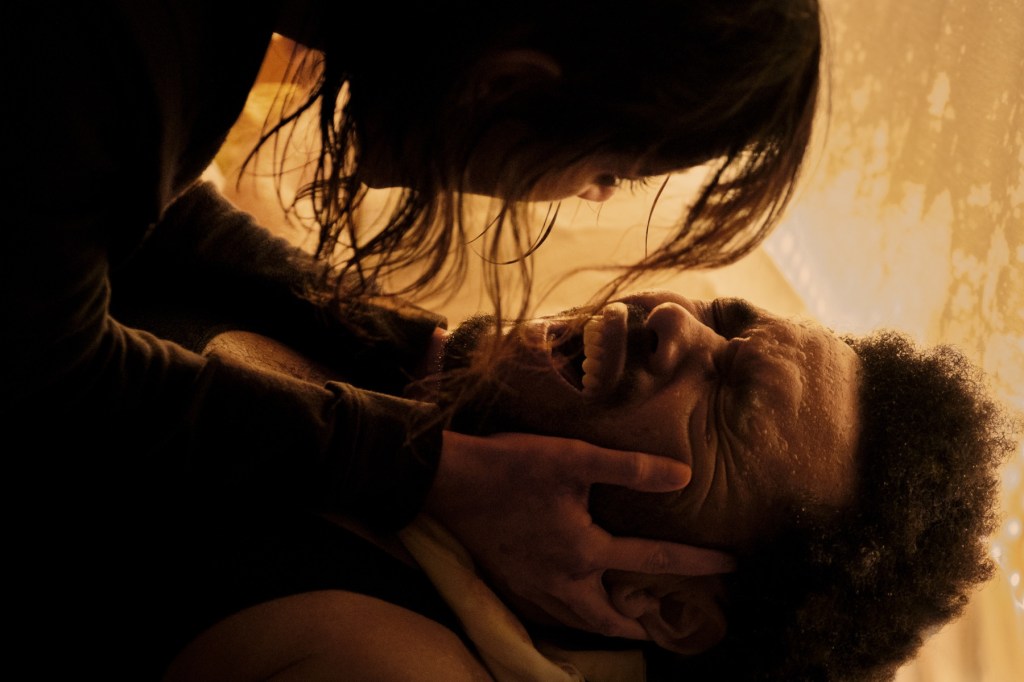
Playing a ‘fictionalized’ version of himself, Abel ‘The Weeknd’ Tesfaye is a depressed musician who is crying for help and no one can get through to him, despite his manager Lee (Barry Keoghan)’s best efforts. Anima (Jenna Ortega) is an angry young woman who has just burned down someone’s house for reasons that aren’t immediately clear. At one of his concerts, the two lock eyes and seemingly share a powerful connection. Things go sideways when she knocks him out and ties him up in a hotel room bed.

There’s a joke reused a lot on social media lately about the lengths men will go to in order to avoid going to therapy. And if Tesfaye had any self-awareness at all, he would not be releasing this movie out into the world right now. There are a million reasons why, but the central one is that this film is the cinematic equivalent of that joke. As a piece of storytelling, Hurry Up Tomorrow is shockingly hollow and devoid of anything emotionally worthwhile or anything worth going to the movies for. It’s almost impressive how little there is here despite the pedigree involved. There is almost nothing to latch onto here emotionally and I cannot understate how I felt literally nothing throughout this seemingly endless, excruciatingly repetitive experience. Hurry Up Tomorrow makes Mariah Carey’s Glitter look like Citizen Kane, and I can’t see this being worth it for anyone except The Weeknd’s most fanatical, obsessive fans.
A fact that everyone who watched The Idol already had learned and I guess now I had to learn as well, is that The Weeknd is simply not an actor. And that’s almost too polite, he is a terrible actor. And he’s not a film producer or screenwriter either. And yet he’s doing all three jobs here, and he is so deeply ill-equipped in every regard, it almost feels like he is actively trying to humiliate himself and he has some kind of shame kink and gets off on this. It’s clear there’s something he thinks is emotional and profound that he wants to say here, but he never knows how to say it. Maybe he’s not emotionally intelligent enough to clearly articulate his demons, or maybe this is all a cynical attempt to cash in on the mental health epidemic plaguing the younger generations right now. Either way, there’s something deeply disingenuous in the proceedings here, something that the film never manages to recover from.
And it’s not enough for The Weeknd to simply humiliate himself, he’s got to bring two of Hollywood’s most promising younger stars down with him. Jenna Ortega, who is booked and busy these days, plays Anima, who is never once referred to by her character’s name and I had to Google this to see if her character even had a name. Anima is the perfect girl who turns into the classic crazy bitch archetype, and both of these feel reductive. It’s about an hour into the movie before Ortega even has a line of dialogue. We know so little about her, and really none of it matters, because her character trajectory from arsonist psychopath to manic pixie dream girl to Kathy Bates in Misery, more or less, almost makes no sense, and maybe it would have if Tesfaye and co. cared about the female character in general or wanted to give Anima a sense of agency or purpose, like her life would exist outside the world of The Weeknd, but it doesn’t. She is mainly just an idea, like the troubled young woman who just might save the flawed man. And it’s misogynist, exhausting and insulting.
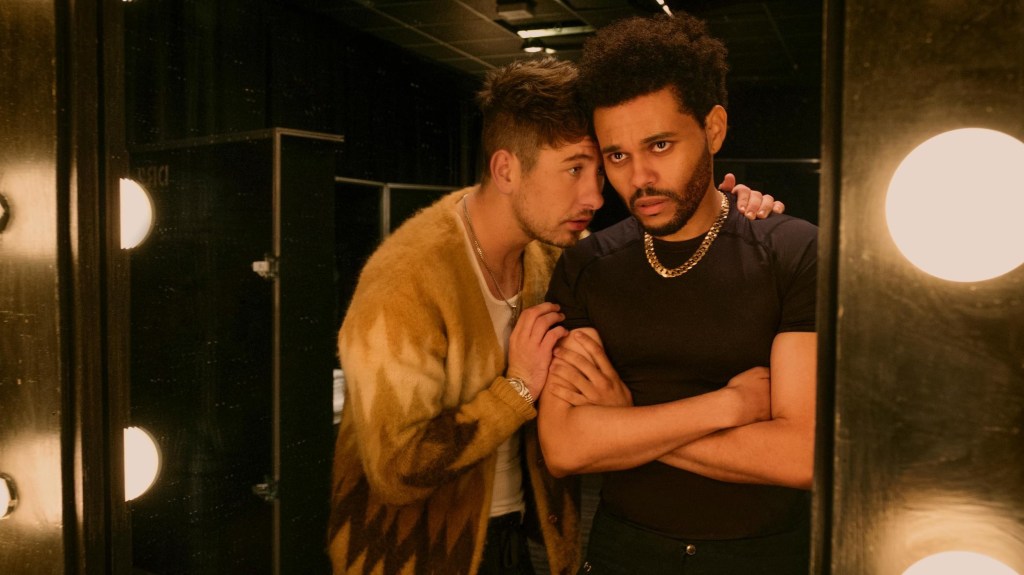
Meanwhile, Barry Keoghan doesn’t get out of this unscathed either. He’s playing Abel’s manager and he’s got one note to play as the quintessential hype man. And that’s it. He’s doing his native Irish accent, so it’s not like he’s putting a ton of work into whatever this film is. His character, like Ortega’s, has just glimmers of a life outside of the lead character’s existence, and mainly exists to serve as an extension of what our leading man is experiencing. And that kind of character is not necessarily a bad thing, but when you have a main character as dead behind the eyes as we do here, it’s a problem.

I have not particularly enjoyed the previous Trey Edward Shults films that I’ve seen, and some of the frustrating filmmaking choices that plague his earlier films are present here as well. Cinematographer Chayse Irvin shot this, and I guess this is a trademark of Shults’ work now, but the way we shift back and forth between different aspect ratios at different points in this movie for no apparent reason is deeply annoying. There are some nice longer, extended shots but every time the movie does this, it just feels like the cinematographer trying to flex in the most surface-level way, and the way this film is shot and edited truly gave me a headache by the time the house lights went up. The soundtrack is great if you’re a fan of The Weeknd, but even if you’re a casual fan like I was, you might leave this film hoping you never hear another one of his songs again.
Hurry Up Tomorrow is more of an endurance test than a feature film, and it will test the patience of any casual viewer who does not enter the theater already entirely buying what The Weeknd is selling. Hurry Up Tomorrow was conceived as a companion piece to his most recent album, and one has to wonder why this film was not included in some sort of deluxe album, or released to a streaming service in conjunction with the album. Why is this a feature film presented to audiences in wide theatrical release in a busy time of year when it’s really not for anyone else besides the subject’s most obsessive fans? As a piece of storytelling, it’s shockingly hollow, self-indulgent, inept and impossible to recommend. As an argument for The Weeknd’s acting abilities, it’s DOA. Even as a deconstruction of what it has all meant, regarding his career as a whole, despite its insistence of its own brilliance, it has absolutely nothing to offer audiences. It’s essentially a disjointed selection of music videos with no apparent thesis statement or message to take away. Tesfaye really wants you to applaud his journey and his artistry, but maybe he should just see a therapist instead.
 Salt Lake Film Review