

Pedro Almodóvar is one of my favorite filmmakers. He has made so many fascinating, creatively mounted films over the years and they have always appealed to me. When it was announced his first English-language feature would star Julianne Moore and Tilda Swinton, I immediately got very excited. And that excitement escalated when Almodóvar won the Golden Lion (the top prize) at this year’s Venice International Film Festival. Luckily, I was right to be excited. The Room Next Door, adapted from Sigrid Nunez’s novel What Are You Going Through, might fall among the filmmaker’s most emotionally compelling films.
Ingrid (Julianne Moore) and Martha (Tilda Swinton) were friends who once worked at the same magazine when they were in their twenties. At a book signing, Ingrid hears that Martha has suffered a cancer diagnosis and goes to visit her in the hospital. They reconnect, and after some time passes, Martha’s condition worsens and she decides not to continue treatment. She decides she wants to rent a house in the country for a month, go there, take a pill and end her life, and she wants Ingrid to come with her.

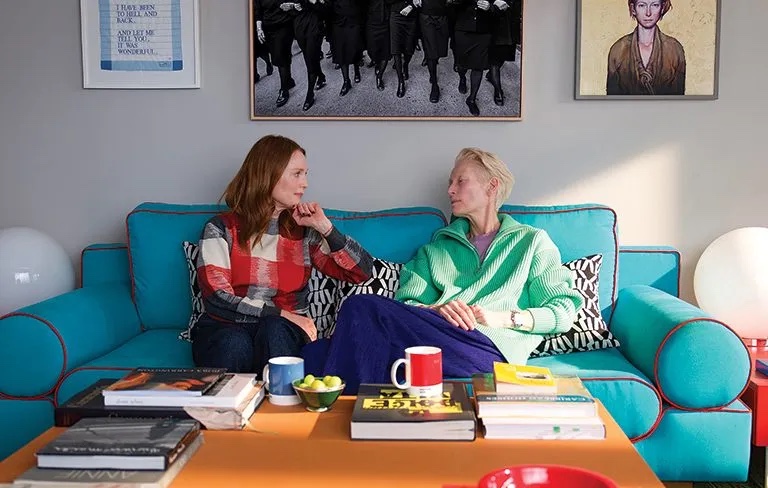
The one-two punch of the Tilda Swinton and Julianne Moore performances is the centerpiece of The Room Next Door. These two remarkable actresses, still very much in their prime, play off each other in a way that feels inspired, naturalistic and grounded. You really do believe these two women have been friends for many years, and their relationship feels lived-in and personal. This is a scenario where I have no idea which actress you would put in lead or supporting actress. Putting one in one and one in the other would no doubt constitute category fraud. They are both bringing so much to this project at all times, and make it feel so effortless, and this film falls among both actress’s finest performances.
We have John Turturro co-starring as Damian, a past romantic interest of both women, who is still in touch with Moore’s character. I feel like Almodóvar is using him as a soapbox to talk about what he finds to be wrong with the world, but the observations this character makes stop just short of being condescending to the viewer. Besides that, this is really a definitive two-hander. Both Moore and Swinton are with us through the entire story, and the nuance both actresses are bringing to their performances are more than enough to get us through this difficult story.
If I had a complaint, I would say Almodóvar’s screenplay feels a bit clunky, as if it were put through some kind of translation software to make it work for the English-speaking actors. We have lots of monologues here, some that illustrate your understanding of these characters, and some that kind of grind the film to a halt. We also have some flashbacks in the first 30 minutes or so of this film, flashbacks that end up meaning nothing, as they don’t really play into anything important later on. As an audience, hearing these two women describe these events, rather than having to see them, would have sufficed. You get the idea we’re only seeing these things play out onscreen because it gives Almodóvar a chance to play around with period detail and costume design.
Having said that, the costume design by Bina Daigeler is thrilling. Both actresses get so many wonderful coats and sweaters, and the use of color, a staple in Almodóvar’s films, is incredibly striking. The production design by Inbal Weinberg, who I was surprised to learn, has not worked with Almodóvar previously, is stunning. The details of this house, the sharp edges, the use of glass and shadow, and the even the furniture design in this house and these apartments. The rented house is the kind of Airbnb that only exists in movies, the kind where the entertainment center just happens to have a DVD collection including John Huston’s The Dead, that our two lead characters watch one night. And there’s a thing in the last ten minutes or so of the film that is a bold, soapy, Almodóvar-ish choice that I feel worked perfectly, but I could see others being a bit baffled by.

The Room Next Door is an emotionally complex and heartbreaking meditation on friendship, morality, mortality and grief. Almodóvar does a fine job at maintaining all that has made his films so special for all this time, and literally bringing it all into a new language. Julianne Moore and Tilda Swinton are both giving the kind of powerhouse performances we consistently see from them, and the pairing of these two actresses for Almodóvar’s first English-language film feels like an inspired choice. The film will give you a lot to think about afterward. I gave myself a few days after seeing it to write this review, because the implications of the themes presented here would not leave my mind.
Ultimately, The Room Next Door is not top-tier Almodóvar, but it’s definitely one of his best films of the last decade. He’s a filmmaker who is constantly surprising me and giving me stories I would never have thought would work. He has such reverence for his actors, and I am always excited to see what kind of work he gets out of them. The Room Next Door is powerful, haunting and stunningly beautiful. I watched it at home on a screening link, but I will absolutely make the trip to my local cineplex when it goes into wide release. I suggest you do the same.
 Salt Lake Film Review