
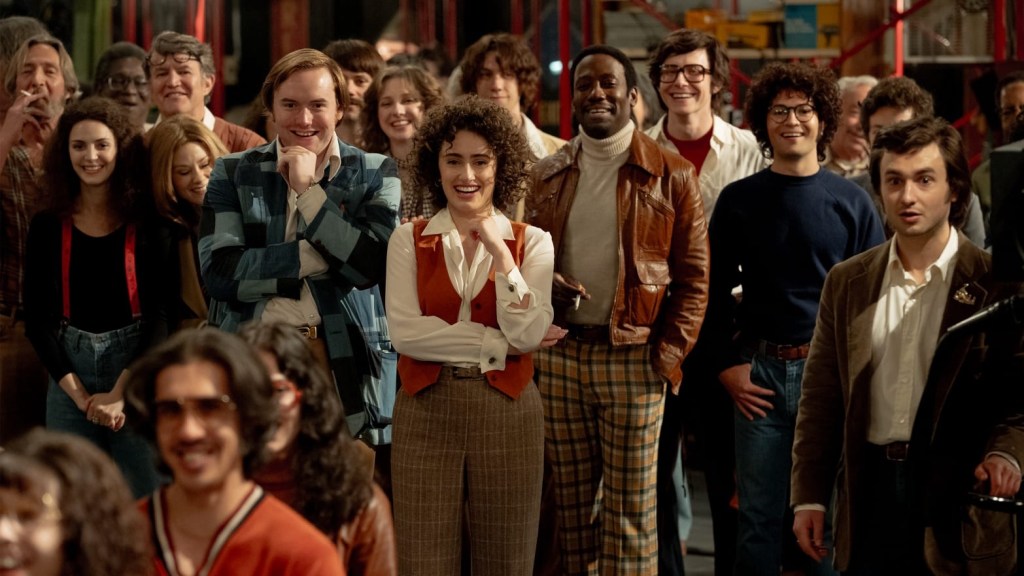
Jason Reitman is a filmmaker I really enjoy about half of the time. Movies like Juno, Up in the Air, Young Adult, Tully, all very strong comedies with emotional cores that hit you unexpectedly. But he’s also made a lot of garbage, and for the last decade or so, he’s largely been on something of a slump. The idea of him directing a film based on what happened the night of the first ever episode of Saturday Night Live intrigued me. It could really work, it could fall flat. I’m very surprised and pleased to report that Saturday Night is one of the strongest films in Reitman’s career, and one of the most enjoyable theatrical viewing experiences I’ve had in some time.
Lorne Michaels (Gabriel LaBelle) has been given the green light by execs at NBC to mount the show that would later become Saturday Night Live. We open on October 11th, 1975 at 10pm EST. We follow the cast, the crew, the people in suits deciding if this unfinished script from a bunch of unpolished performers who have yet to prove themselves, will air as scheduled. We follow the behind-the-scenes chaos of that night, pretty much in real time, leading up to the 11:30pm airtime.

It is genuinely impressive for Reitman to create genuine stakes out of something that we all know the ending to. We know Saturday Night Live eventually became the massive staple of television that it remains to this very day, now in its 50th season. We know all of the people involved with this production would go onto enjoy massive successes of their own. And yet, as a viewer of this film, you really do believe that everything here could spiral out of control at any given minute, and that makes for a very exciting and stressful viewing experience. I felt like I was on edge for this entire runtime, and that is a testament to not only Reitman’s filmmaking, but also the screenplay he co-writes with Gil Kenan, and a terrific ensemble of expertly chosen performers (mostly unknowns, like the original SNL cast) who all get moments to make a strong impression.
Gabriel LaBelle recently played the lead character in Steven Spielberg’s The Fabelmans, a character that was very much a stand-in for the director himself. And he’s a terrific Lorne Michaels, because while he mostly plays the character sympathetically, there are moments that are very telling of the kind of ruthless boss Michaels would later become. Rachel Sennott, fresh off great parts in films like Bottoms and Shiva Baby, is also excellent here as his wife and creative partner Rosie. Cooper Hoffman, son of the late Phillip Seymour Hoffman, previously having made a strong impression in Paul Thomas Anderson’s Licorice Pizza, is also very good here as an NBC exec who is still learning the ropes.

And then we have our cast playing the big names, and we’ve got some spectacular casting choices here. Specifically, Corey Michael Smith as Chevy Chase, Ella Hunt as Gilda Radner, Matt Wood as John Belushi, Lamorne Morris as Garrett Morris, and Dylan O’Brien as Dan Ackroyd, are all exceptional picks to play their very recognizable real life counterparts, and each of these actors gets a moment or two to really show off their impression skills, and yet all of these actors make these portrayals that could feel like caricature, feel like fully realized people.
We also have Willem Dafoe as an imposing executive threatening to air a re-run of The Tonight Show in place of Saturday Night, and J.K. Simmons as a kind of villainous Milton Berle, and both of them are very fun to watch. Matthew Rhys pops up as George Carlin, and Succession’s Nicholas Braun appears as Jim Henson. We have Broadway’s Andrew Barth Feldman, also recently seen in the very good Jennifer Lawrence film No Hard Feelings, as a newly hired and very stressed out talent coordinator. If I went into the details and nuances that make all of these performances work, we would be here all day. But suffice it to say Saturday Night makes a solid case for why we should be considering an Academy Award for best casting.
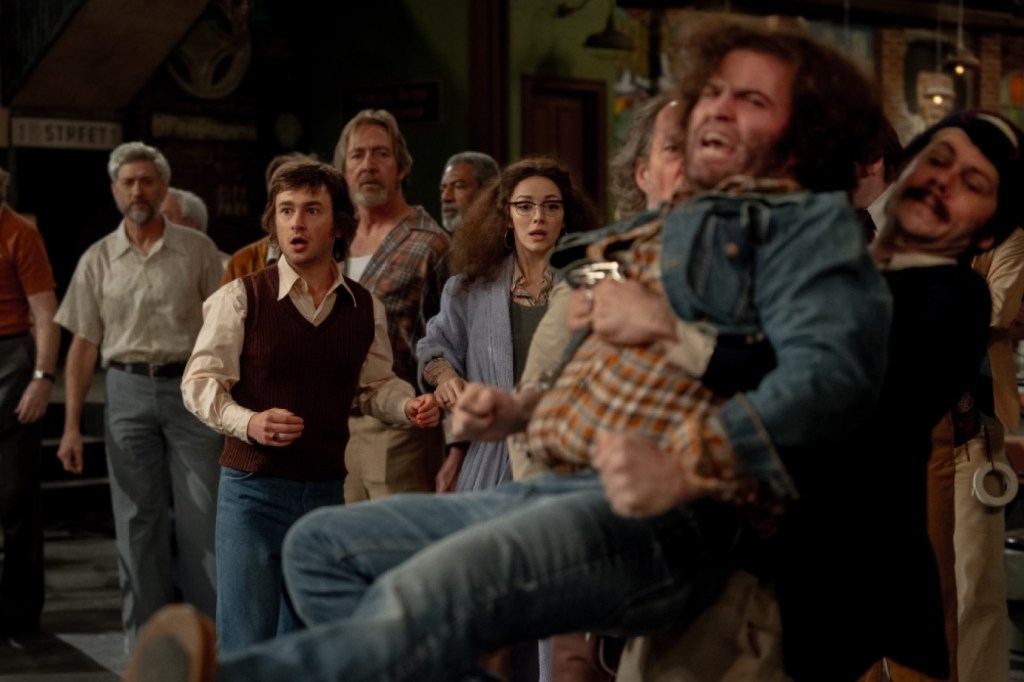
Saturday Night mainly works because of the zippy, breathless pace, the icepick sharp screenplay and the performances, but this is also just a very well made film in all respects. Reitman’s usual DP Eric Steelberg shot this on 16mm film, giving the look of this film a graininess that makes it feel like it could have existed in 1975. Steelberg does lots of long, unbroken shots that introduce you to multiple characters and cover lots of ground in single camera takes. We do this so much, it made me wonder how much more work it would have taken to do this entire movie as a one-take experiment, a la Birdman and 1917. This mood set by the cinematography is elevated by Danny Glicker’s very specific period era costumes, and a jazzy, tense, kinetic score from Jon Batiste who also appears in the film as Billy Preston. But the big thing here is the editing, by Nathan Orloff and Shane Reid, which creates the high-anxiety atmosphere that is so integral to this film’s success.
I’m often so critical of point-at-the-thing-you-know cinema, where the viewer’s nostalgia for whatever’s onscreen is a thing that can determine how they feel about it. So, I’m going to sound like a hypocrite here but I don’t care. Saturday Night feels like a historical document that also somehow has an alive, beating heart and a blood pressure going through the roof. It’s incredibly well cast, it’s paced like a rollercoaster ride, one with plenty of laughs along the way. Seeing this film with an enthusiastic crowd has been one of the most exciting viewing experiences I’ve had all year.
 Salt Lake Film Review