
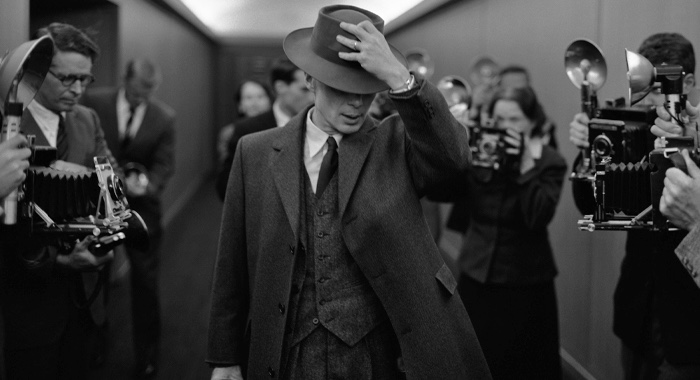
I’m very hit or miss with the films of Christopher Nolan. I appreciate him because he possesses undeniable artistic talent and he’s very committed to the importance of keeping filmmaking theatrical. Shooting on film over digital, insisting you watch his movies in theaters and not streaming, forcing theaters to show his films on actual film stock and not as a digital file that movie theaters press play on, etc. But after the way Nolan handled the release of Tenet, the first major theatrical release following the COVID-19 shutdowns, a film released when the pandemic was still very much at full threat, my tolerance for his whole thing kind of dipped. Especially considering that Tenet was probably the worst film of his career. However, Oppenheimer shows a famed director who I’ve never really liked, at possibly his best.
Oppenheimer feels like three movies in one. The first of three hours follows the earlier life of J. Robert Oppenheimer (Cillian Murphy), and his political aspirations, his relationships with women, his interest in quantum physics research, prior to World War II. The second hour shows Oppenheimer leading the Manhattan Project, and the development of the atomic bomb, and what happens when it erupts. The third hour is about the aftermath of this, and what happens when the United States government tries to discredit him in the wake of the Cold War. The third hour is also about Oppenheimer’s guilt over what he’s created and what it means to create something that has killed many, many people.
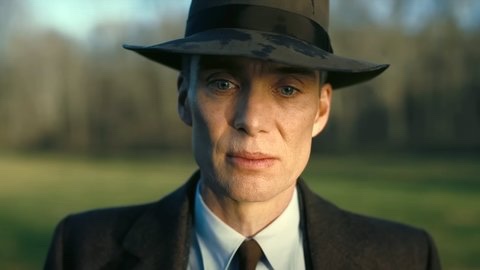
Oppenheimer is probably Christopher Nolan’s strongest film since Inception, and yet it’s sometimes a bit of a slog, especially in the first hour of its three-hour running time. The majority of the film is men in suits talking in boardrooms about quantum physics and numbers and (gulp) math. So, as a result I was a bit bored in that first hour. There’s such a rapid-fire quality to the dialogue and it’s full of people reciting the kind of biopic dialogue that feels very writerly and unrealistic. The kind of dialogue that would never come out of the mouths of actual human beings, and that kind of thing can become exhausting quickly.
The second hour is about the process of designing the atomic bomb, creating the area where it would go off, and trying to limit the number of people impacted by it. This is where my interest level goes up slightly. Nolan has always been interested in process, and his films are best when they’re about the buildup to a big event. And when we finally get to the big event, something happens with the sound design that really takes advantage of the epic scope of this film and makes it truly something astounding to see.

The third hour is where everything Nolan has been trying to do in Oppenheimer finally starts to work at full capacity and the film becomes as compelling as it’s tried to be this whole time. It’s where our lead character who has been very cocky and self-involved up until this point has to deal with the ramifications of the thing he has put into the world and what he is responsible for. When the bomb goes off, you’ll look at your watch and say ‘ugh, why is there another hour of this?!’, or at least I did. But this is where you should actually trust the filmmaking style of Christopher Nolan, because that third hour is where the good stuff is.
And Cillian Murphy is doing some career best work. His career is full of standout supporting performances but it’s rare that he gets top billing, and Nolan’s script gives him the kind of material he so rarely is given, and it’s undeniable this is an Oscar-season ready performance. Robert Downey Jr. has been savvy about the projects he’s taken on post MCU, and his performance as Lewis Strauss starts off as not much, but elevates as the film progresses and Downey reminds us how much he still has to offer audiences.
Emily Blunt, playing Oppenheimer’s wife, initially feels like she is going to get sidelined in the way female characters so often do in Nolan films, but she, too, has some great moments in the third hour that stick with you. Can’t say the same for Florence Pugh, however, who’s stuck with a pretty lousy character that doesn’t give her much to work with. Other than that, every character actor you’ve ever enjoyed seeing, basically, is in this movie, and it’s a lot of fun to see people like Josh Harnett, Casey Affleck, Rami Malek, Benny Safdie, Dane DeHaan, Alden Ehrenreich, Tony Goldwyn, Matthew Modine, Jason Clarke, Josh Peck, Olivia Thirlby, Alex Wolff, etc. show up in blink-and-you-miss-them roles.

Nolan’s usual cinematographer Hoyte van Hoytema shot this, and it sure looks great. There’s an ongoing thing where scenes will go back and forth from black and white to color, and the casual viewer will have no idea what’s intended here. Nolan has stated in interviews that the black-and-white scenes show the objective historical point of view and the color scenes are subjective, from the character’s perspective. However, as a causal viewer there is no way to know this, as sometimes the shift will occur multiple times mid-scene, mid-conversation. I think it’s mainly just Nolan trying to add shameless stylistic flourishes, and there is really no deeper meaning to the shifts between black and white and color.
Naturally, Nolan is again begging audiences to see it in his preferred format, 70mm IMAX. I saw it in a cushy Cinemark XD theater, with a reclining seat in a theater where the air conditioning was on full blast through the whole thing. I think I saw it the best way possible. The expanded IMAX aspect ratio would probably be nice, however I didn’t see anything here that I think would really benefit from the expanded IMAX ratio. Go see it, but go see it where you’re comfortable, because this is a long sit, and the easier you can make it on yourself, the better.
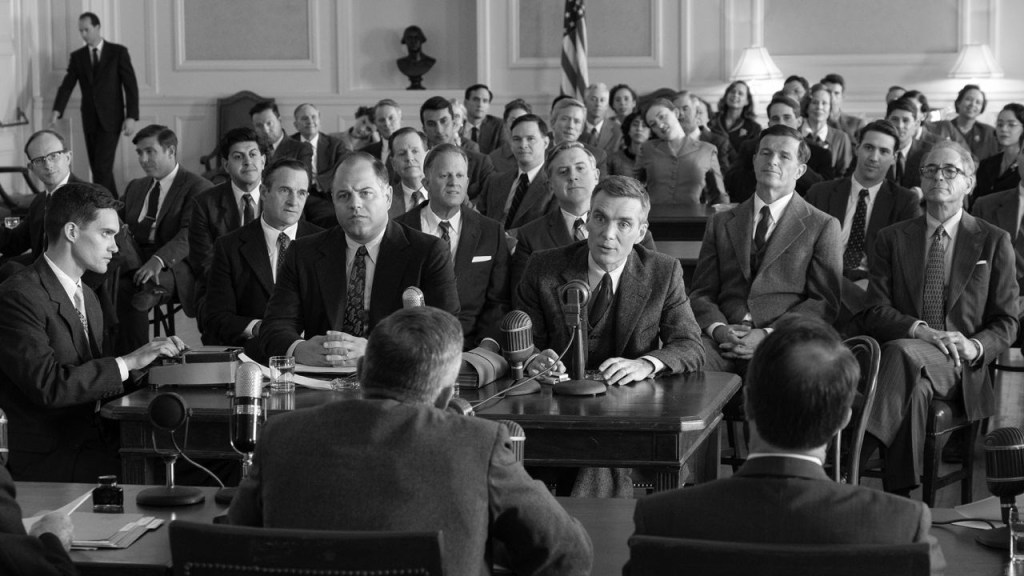
See it on the biggest screen you can find with the best sound possible. This is probably best experienced in a Dolby theater with the reclining seats that shake and move to the sound of the action onscreen. The score by Nolan’s usual composer Ludwig Göransson sometimes sounds terrific and adds to the tension, and sometimes feels oppressive and overused, and can almost take away from an actor’s performance. It certainly messes with a great Emily Blunt moment, and that annoyed me.
Overall, I would say Oppenheimer as a film is a lot like its protagonist – brilliant yet flawed. This is easily one of Christopher Nolan’s better films and yet it gives him free rein to indulge in some of his cinematic habits that annoy me. He still doesn’t know how to write for female characters, and yet he’s getting better at depicting human emotion. And the grand, epic scale of this story and the importance of it, are selling points that Nolan is able to elevate rather than diminish. Nolan manages to make this historical epic, which could feel a lot like homework, feel kind of exhilarating and thrilling to behold. Aspects of Oppenheimer are overwrought and potentially frustrating, but when it works, it really works.
 Salt Lake Film Review