
I have a varied and somewhat antagonistic relationship with Wes Anderson films. Sometimes I feel like I get his whole thing. The emotional substance underneath his signature style can sometimes come through amidst all the noise. Sometimes I can find his whole thing insufferable. I vehemently disliked his most recent outing The French Dispatch, for instance, which felt like a string of shorts that amounted to nothing – a love song to those who still carry their belongings in a The New Yorker tote bag on public transit. And that’s become a frustrating metaphor for what his films have felt like lately in a general sense – self-indulgent slogs for a very specific kind of viewer, and all others need not apply.
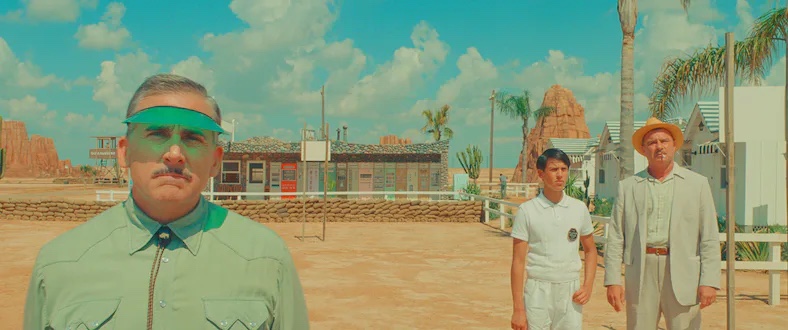
Asteroid City follows a group of young students who are gathered for a Junior Stargazer convention in a fictitious desert town in the mid 1950s. Their itinerary and plans are disrupted by a supernatural event that forces this small town to go under a mandatory quarantine and discuss the meaning for their existence, and what’s brought them there.
Asteroid City is a more cohesive Wes Anderson film, and yet I wouldn’t say it’s for the uninitiated. It does ultimately come together thematically and yet still lets Anderson indulge in his most annoying impulses. There’s a whole radio-play-within-the-movie subplot happening that pays off in one throwaway joke, (you’ll know it when you see it) but otherwise feels like it’s beside the point entirely. We keep cutting to title cards that distinguish scene breaks and a spot for an intermission, a prologue and epilogue, and this just feels a bit hacky and self-indulgent in the way I expect, but kind of hate in a Wes Anderson film.

We have the usual murderer’s row of ensemble players, including lots of Anderson’s repertory cast, notably missing Bill Murray this time. While the names fly past you on the screen in the opening titles, you feel like you can’t possibly catch all of them – Jason Schwartzman, Scarlett Johansson, Tom Hanks, Jeffrey Wright, Tilda Swinton, Bryan Cranston, Edward Norton, Adrien Brody, Liev Schreiber, Hope Davis, Maya Hawke, Steve Carrell, Hong Chau, Matt Dillon, Margot Robbie, Willem Dafoe, Jeff Goldblum, just to name the majority. Everyone probably showed up on set for a day or two.
And yet, the characters here feel like almost nothing at all. Jason Schwartzman and Scarlett Johansson (maybe Tom Hanks) get the most to do, and they come the closest to establishing some kind of emotional connection with the audience. And yet, even their performances are trapped in the monotone emotionless nothingness of the Wes Anderson character template.
I will say Asteroid City is an undeniable visual feast. Re-teaming with his usual cinematographer, the Oscar nominated Robert Yeoman, everything has the kind of gauzy look of a memory, a time Anderson seems to feel nostalgia for despite never having lived it. His usual production designer Adam Stockhausen returns, and like Anderson’s other works, the sets have a visual language of their own that gives the viewer a lot to take in, in every frame. Along with some great costumes (lots of pointy sunglasses and neckerchiefs) from Anderson’s usual costumer, Oscar-winning Milena Canonero, everything is designed so specifically and immaculately, the viewer is bound to be taken with all of the technical details. Would be nice if the film around them amounted to more, though.
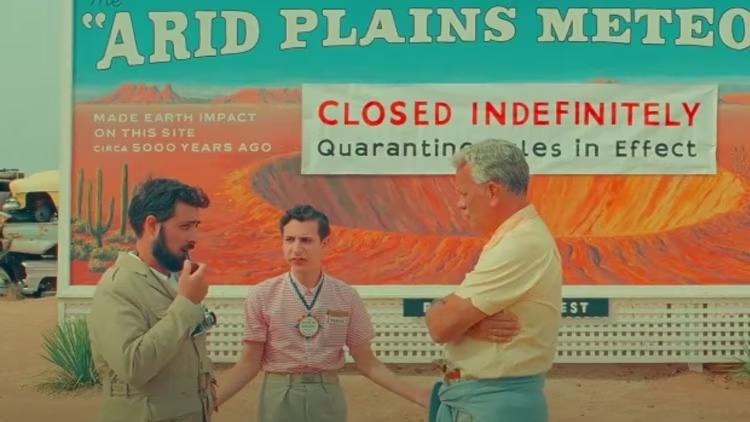
You feel like there are actual themes and real-world elements that Anderson wants to tackle here, amidst his usual twee and cutesy sensibility. Is Asteroid City his pandemic movie? Seems like it could be. Is it about American fear and panic and the way that is ingrained into our lives and our culture, and how we’re taught to be afraid of the unknown from an early age? Maybe. Although, that might be giving Anderson too much credit. I don’t know if there is really a way to know what this film’s thesis statement is, because the script itself feels too unfocused and dizzying to really set itself into any sort of recognizable reality. It feels like Anderson is making films for himself at this point, and he’s less interested in attracting new viewers. I would recommend Asteroid City to moviegoers who know what they’re getting with him. I would advise others to approach with caution.
 Salt Lake Film Review